62° and Clear



Image
Colin Young |SHNS
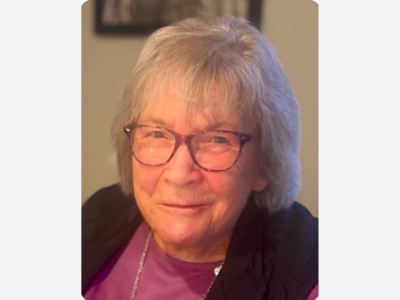
When she walks into the State House this week, Medway State Senator (and a former Senator for Franklin, too) and the Senate President, Karen Spilka will be doing something no one
has done -- or been allowed to do -- since the mid-1990s: leading the
Massachusetts Senate into a ninth consecutive year.
Spilka was first elected president of the Senate
on Thursday, July 26, 2018, eight years ago Sunday. When she took the
gavel, the Senate had a rule adopted 25 years earlier barring anyone
from holding onto it for more than eight consecutive years. Had it not
been wiped away by Senate Democrats three years ago, it would have
forced Spilka to give up her power this weekend.
But now, the
timeline for a leadership transition is almost entirely in Spilka's
hands. She told the News Service on Thursday, "We've done so much, but
we still have more to do" and she suggested she is not thinking about
handing off the gavel.
"Honestly,
I don't know. But I do believe that I will know when it's time to go,
and that's when I'll go," she said in her third-floor State House office
when asked how long she wants to remain president.
She has, though, signaled she is not leaving imminently. "I decided I am running for president...of the Senate," she told
NBC10 Boston's Matt Prichard in a May 2025 interview. Being elected
president again in January 2027 could boost her tenure atop the Senate
beyond a decade.
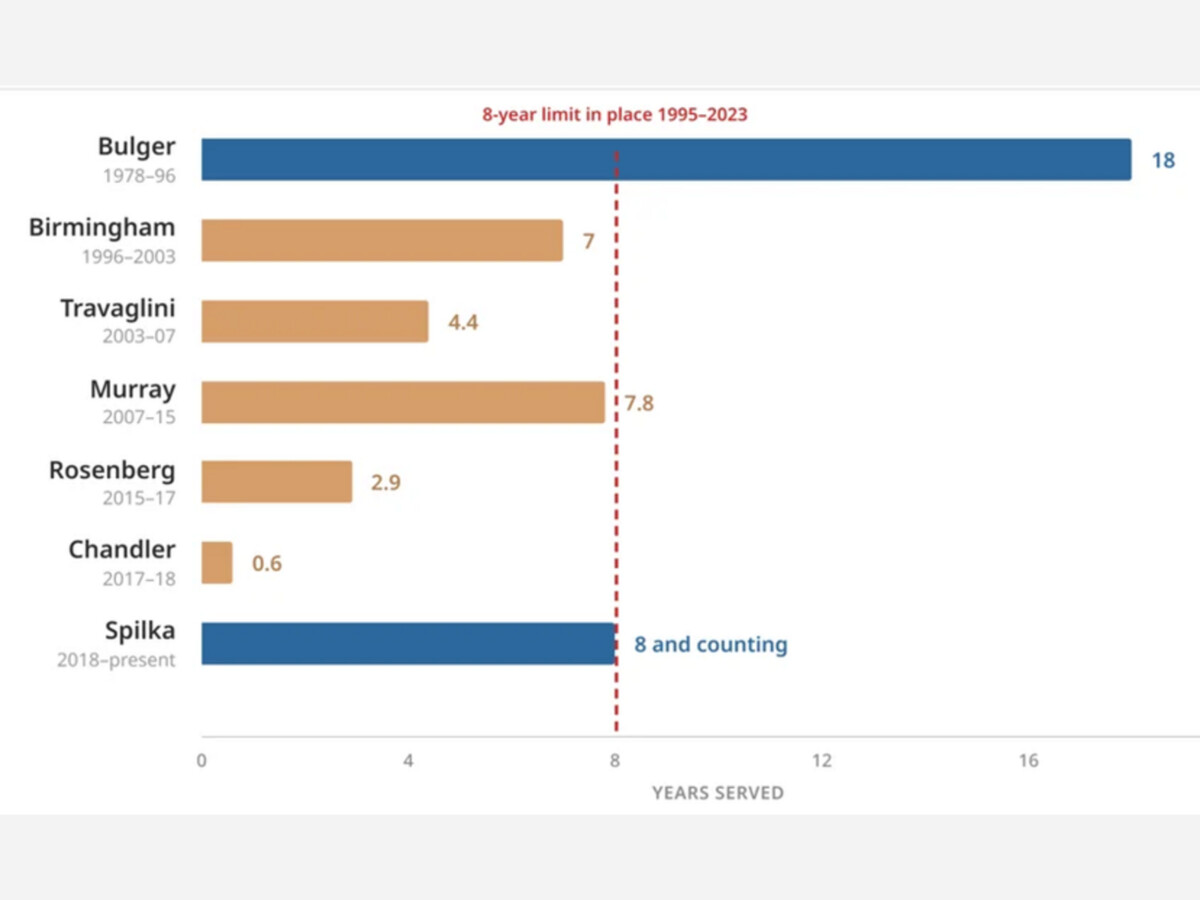
This
May, she became the modern Senate's second-longest-serving president,
behind only President William Bulger's 18-year tenure.
For
years, the cast around Spilka in Senate leadership has barely changed
and the Senate has run with little drama. The one blip in that
steadiness came in the middle of November 2021, when she had what she
called a "mild stroke," dropped from public view for weeks, then was back presiding by late December.
That
steadiness was not always a given. When Spilka first took the gavel
eight years ago Sunday, she inherited a Senate in turmoil -- but also a
job she had maneuvered toward for years.
"I've
been wanting to do that for a long time," the Ashland Democrat who
worked as a labor lawyer and mediator before being elected to the
Legislature in 2001 said as she banged the gavel for the first time as
president.
In her
speech that day eight years ago, Spilka, 65 at the time and 73 now,
alluded to the complex circumstances that led up to her presidency,
saying the Senate had recently "experienced difficult times" but was
about to "write a different story."
"As
we turn the page and look to the future, I pledge to uphold and
maintain the integrity of the Senate – for the public and for each and
every senator, staff member, advocate and intern that passes through our
doors," Spilka said, drawing applause.
In
her time atop the Senate rostrum, Spilka has pursued expansions of
mental and behavioral healthcare services, updates to the way the state
funds local education, stronger protections for reproductive rights and
abortion care, a reform of the criminal justice and police
accountability systems, and additional protections and state
documentation for immigrants. She also guided the Senate through the
COVID-19 pandemic and into a hybrid era that has seen some rules
loosened and Senate customs altered.
She
said she draws from her professional background in social work and
conflict resolution to lead the Senate towards consensus and
collaboration.
"I
believe in my bones, deeply, in a collaborative style ... whether you
call it shared leadership or collaborative consensus building, that's my
style of leadership in the Senate," Spilka said Thursday.
She
added, "My caucuses go until people have nothing more to say. So if
it's an hour, or three hours, or four hours, we talk it out."
Raised
in Yonkers, New York, Spilka moved to Massachusetts after graduating
from Cornell University, and worked as a waitress until she found a job
counseling kids. She attended law school at Northeastern University to
focus on juvenile justice, and went to work as a labor lawyer and later
as a mediator.
In the late 1990s, she said in 2018,
she ran for a school committee seat "because, to be blunt, I was pissed
off about something that was going on in my district." She became
active in lobbying for reforms to the state school funding formula,
which she has further addressed twice as Senate president.
She
won a 2001 special election to succeed Rep. John Stefanini in the House
of Representatives, and has said she visited the State House for the
first time on the day she was sworn in.
Spilka
arrived in the Senate in 2005 after serving three years in the House.
She became the Senate chair of the Joint Committee on Children, Families
and Persons with Disabilities and later co-chaired the Joint Committee
on Economic Development and Emerging Technologies. She has long been
active in economic development and animal protection issues.
Under
Senate President Therese Murray, who stepped away from power due to the
old term limit rule, Spilka rose in the ranks of leadership to become
an assistant majority leader before she was tapped by Senate President
Stanley Rosenberg to take over the budget-writing Ways and Means
Committee when he took power in 2015. She ran for Congress in a 2013
special election to replace U.S. Sen. Edward Markey in the House, but
came in fifth in the seven-way Democratic primary.
But
Spilka's ascension to the presidency played out amid disorder in the
Senate, not as the conclusion of a more traditional succession.
Rosenberg gave up the presidency in December 2017 amid a scandal centered around his husband, Bryon Hefner, and as an Ethics Committee inquiry took shape into whether he'd enabled his husband's alleged misconduct,
which included allegations that Hefner sexually assaulted men with
business pending on Beacon Hill and bragged about his alleged influence
in the Senate. Rosenberg would resign his seat entirely five months later, sealing the abrupt end of the "shared leadership" style Rosenberg preached in the Senate.
Spilka was among a handful of senators who publicly made an interest in the presidency
known even before Rosenberg stepped down from the office, along
with Sens. Eileen Donoghue of Lowell, Linda Dorcena Forry of Dorchester
and Sal DiDomenico of Everett. Sens. Eric Lesser of Longmeadow and John
Keenan of Quincy joined the jockeying later, and Forry left the Senate
before the matter was settled.
Faced with an immediate void in the president's suite, senators installed Majority Leader Harriette Chandler
as a caretaker president in a dramatic full-Senate caucus that
stretched into the night. Chandler was initially given the title
"acting" president and the Worcester Democrat made clear from the outset
that she didn't want the job long-term, allowing for a scramble to play
out among several other Democrats who wanted a more firm grasp on the
gavel. But in early 2018, the Democratic caucus voted to strip the
"acting" prefix from her title and voiced support for her to remain in the role through that year.
"An
election will be held on the first date of the 2019 season, which is
January 2, as is the normal course of business for the Senate," Chandler
said, adding that she would not seek the presidency at that point.
Spilka, then Ways and Means Committee chair, locked up the required votes
by March 21, 2018. She never released her initial list of backers, but
the News Service reported at the time that her claim to the presidency
was cemented when blocs of Democrats aligned with DiDomenico and
Lesser moved into Spilka's camp with their endorsements.
Spilka
said "it happened, I think, a little bit sooner than folks
anticipated." At the same March 2018 press conference, she declared, "I
am Senate president-elect."
Chandler said she looked forward to "ensuring a smooth transition to Senator Spilka for the 2019 session"; Spilka wanted the handoff sooner. The two openly disagreed over timing at a March 22 press conference, which Chandler tried to end and then walked away from.
Following awkward weeks of behind-the-scenes talks between Chandler and Spilka over timing, the hand-off landed
at an unusual point: July 26, 2018, with five days left on the calendar
for formal session and amid multi-pronged negotiations with the House.
The vote
to make it official was taken in Gardner Auditorium, which was being
used as the Senate's temporary home during renovations of its chamber.
Spilka won 31-7 on a party-line vote, with all seven Republicans
initially backing Minority Leader Bruce Tarr before Tarr moved to make
it unanimous in the record.
The oddly-timed transition further inflamed the tense relationship
between the House and Senate during that time period. Spilka, installed
as Senate president on a Thursday, chose to give senators a three-day
weekend and did not schedule another Senate session until Monday, July
30 -- leaving just two days of formal sessions for a truckload of work.
That upset representatives and House Speaker Robert DeLeo, who said it violated an agreement he had struck with Chandler to hold formal sessions that weekend and that he "presumed" Spilka would honor it.
"Senate
President Spilka has just taken over, I wish her the best. I'm looking
forward to working with her and all of that. But right now, in 2018,
we've got issues that we have to deal with," DeLeo said.
On
that day eight years ago, Spilka became the 95th president, the third
woman to lead the Senate, and its third Jewish president in a row. That
afternoon, an eight-year clock began ticking.
The
Senate imposed a limit on a president's time leading the chamber in
1993, as Bulger's 15 years in charge was starting to wear thin with
some.
Sen. William
Keating was challenging Bulger for the presidency, and had drawn support
from a handful of other senators. Bulger appointed a special committee
that came back with rules reforms
that included the limit, which took effect on Jan. 4, 1995. Bulger left
to lead the University of Massachusetts system in January 1996.
The rule originally covered several other leadership posts before being pared back in 2001 to the presidency alone.
Senate
President Thomas Birmingham made a run for governor in 2002,
approaching seven years in the presidency. His successor, Robert
Travaglini, resigned after about four and a half years as president to
start a lobbying firm.
But
the Senate's eight-year limit on the presidency came into play more
meaningfully with President Murray, who took the gavel from Travaglini
in March 2007.
By
2013, the limit was on Beacon Hill's radar and questions began about the
future of the Senate presidency, and Murray's political career. She
initially said the March 2015 expiration of her time as Senate president
would not preclude her from running for reelection in 2014, but also
declined to rule out a potential run for governor that year.
But by February 2014, with the limit just more than a year away, Murray announced
that she would not run for governor or for reelection, and would end a
22-year career on Beacon Hill that saw her become the first woman
elected to lead the Senate. She told Senate Democrats in a private
caucus that she would finish out her term and not leave early for
another job, and she gave way to Rosenberg in January 2015.
The move
to repeal the term limit on the presidency came fast and early in the
2023-24 session. Sen. Michael Rodrigues -- whom Spilka has repeatedly
picked for the Ways and Means Committee chairmanship that has been a
springboard to the presidency -- filed an amendment to the Senate's
rules package to simply strike the term limit rule.
The
Westport Democrat said he made the proposal after discussing it with
Spilka. The Senate voted 32-6 on Feb. 9, 2023, to remove it following
very little discussion and no debate. The dissenters were the Senate's
three Republicans and three Democrats (Sens. John Keenan of Quincy,
Becca Rausch of Needham, and Walter Timilty of Milton).
Those
who objected argued the limit was worth keeping precisely because it
forced change at the top. Rausch called term limits "a really important
part of small-d democracy," saying they "help advance new visions, new
approaches."
Rodrigues
argued that the Senate president was the lone "Big Three" leader
subject to a limit, which he said weakened the chamber against the House
and governor, especially as any president neared the deadline and
succession jockeying began. Spilka stayed out of the debate and issued
only a written statement about the Senate being "on equal footing."
On
Thursday, she told the News Service that she believes -- "and the
senators evidently believed" -- that the limit on the president's time
in office "put the Senate at a disadvantage … in negotiating with the
House and the administration."
"So I think this equalizes the Senate and the House, especially, and I think that really makes a difference," she said.
For
most of the last two-plus decades, Beacon Hill debate around term
limits has been focused almost entirely on the House of Representatives,
where a cap on a speaker's tenure has been implemented and repealed
multiple times. It has not been in place since 2015, which allowed DeLeo
to become the longest-serving speaker in Massachusetts history in
February 2020.
When
Spilka took over in 2018, the News Service described an era of turmoil
and turnover in the Senate coinciding with historic consistency in the
House.
By early 2025,
the next and most recent time that the Senate rules were up for a
freshening, no senators had filed an amendment to bring back the
president's term limit, clearing the way for Spilka to exceed eight
years and become the second-longest serving president of the Senate in
the modern age, behind only Bulger.
Colin Young is the deputy editor for State House News Service and State Affairs Pro Massachusetts.



Sunny, with a high of 70 and low of 60 degrees. Sunny in the morning, patchy rain nearby in the afternoon, overcast for the evening, clear overnight.