55° and Fog


Image
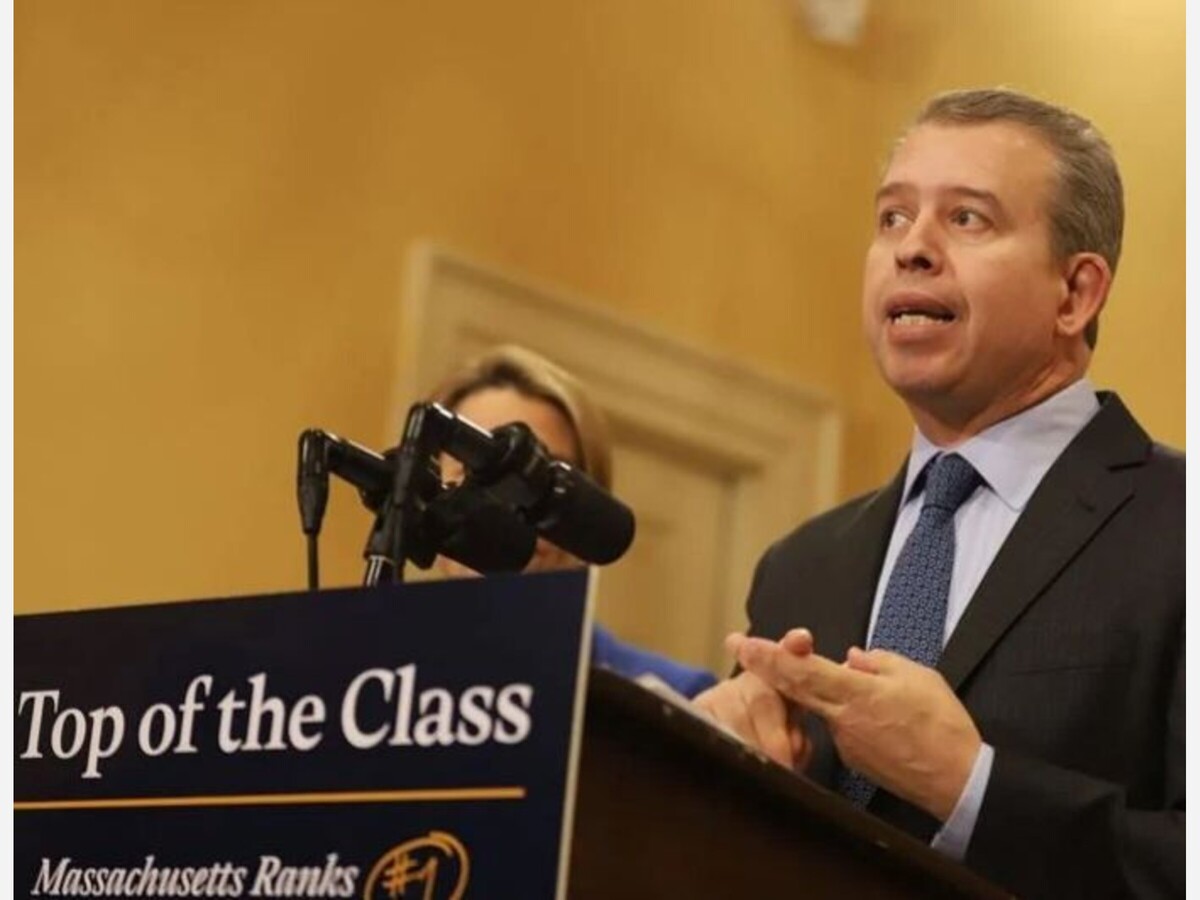
Commissioner of Elementary and Secondary Education Pedro Martinez speaks at a press conference at the State House on Tuesday, March 3, 2026.
Sam Drysdale | SHNS
Massachusetts continues to grapple with early literacy woes and school budget cuts but its students once again have topped the nation on Advanced Placement exams.
New data released Tuesday by the College Board show that 35.8% of Massachusetts public high school graduates scored a 3 or higher (out of 5) on at least one AP exam — the highest rate in the country and the highest in state history.
Participation also climbed, with nearly half of graduates taking at least one AP test, and state officials spotlighted steep gains since 2021 among Black and Hispanic students as exam fee subsidies expanded.
The milestone lands as the state faces sobering academic and fiscal headwinds.
Achievement gaps between demographic groups persist, early literacy scores remain deeply concerning with many elementary students off grade level, and districts from Boston to the Berkshires are grappling with educator layoffs and shrinking student enrollment.
With the landmark Student Opportunity Act nearing the end of its scheduled funding ramp-up, lawmakers are confronting questions about whether — and how — to sustain equity investments that have underpinned recent gains.
"We've been really intentional about increasing these AP exam scores," Gov. Maura Healey said at a press conference. "Now there's a lot of work left to do. We're still recovering from the pandemic, as all states are, and we're working to close any learning gaps. But for me, the ultimate goal is not the number one ranking, actually, it's knowing that we have the very best prepared students in the country when they leave high school."
Massachusetts has been at the top of the metric for the most public high school graduates who scored a 3 or higher on at least one AP exam every year since 2021. Many colleges award students college credit for AP scores above a 3.
Nationally, 24.8% of public high school graduates reached this achievement, compared to Massachusetts's 35.8%.
"That ranking is being driven because more tests are being taken across the state," said Massachusetts Teachers Association President Max Page. "Worcester, Quincy, Springfield. It's good to see that students are being given the opportunities and taking the opportunity."
However, achievement gaps remain wide.
Of the 34,870 white students who took AP exams in Massachusetts in the 2024-2025 school year, 82% of them received a 3 or higher, according to data from the governor's office. That is compared to 63% of the total 10,753 Hispanic or Latino students who took the exams; 57% of a total 4,540 Black students; and 89% of the 9,092 Asian students who participated in the AP in Massachusetts last year.
Asked about these persistent gaps, Commissioner of Elementary and Secondary Education Pedro Martinez said that the first step is ramping up participation across districts.
"We're exposing our students to the rigor, and so that is the first step, and the fact that we have AP courses in 86% of our high schools that we're seeing such significant increases," Martinez said. "What we're doing in Massachusetts is all of our students are rising. Yes, there's some gaps there, but if we keep doing this, and we keep going forward, and you combine this with early college courses, you now have this magic formula."
Page said these disparities are strongly influenced by the "intersection of class and race," and persistent challenges despite recent state investment in low-income districts.
"Pushing for better housing and health care and all of those things, that's a core part of access to opportunities. But clearly, if we continue to invest as we have through the Student Opportunity Act, we can see what happens in communities like Springfield and Worcester, who got a lot of money," Page said. "This was a very durable problem, and it still is... but we still see clearly, we have a long we to go still, because ideally we'd like to see no gap."
Gov. Maura Healey's office promoted gains made among Black and Hispanic or Latino students, who are taking the exams at higher rates and receiving higher scores over the past four years.
Between 2021 and 2025, the number of students of color participating in the AP exam increased by 49%. Massachusetts was the highest ranked state, though still behind Washington D.C., for the percentage of Black students who graduated in 2025 and took at least one AP exam.
Between 2021 and 2025, the number of students of color who received a score of 3 or higher grew 93% in Massachusetts.
The number of students overall taking the tests grew by 26% in those four years, "in part because the state expanded fee waivers available to help students afford the tests," according to the governor's office.
AP exams cost almost $100 without a fee subsidy. Under the Healey administration, the state has started subsidizing the fees, resulting in low-income students paying $22 per test. It's paid for through the 4% surtax on high earners.
"Under this administration, Massachusetts has subsidized 90,783 AP exams for nearly 50,000 low-income students. Students who take AP courses in high school are more likely to enroll in a 4-year college and perform better in introductory college courses," it says.
The Student Opportunity Act, passed in 2019, was designed to phase in more than $1.5 billion in additional aid to districts over seven years, aimed at closing gaps between the lowest-income districts and the wealthiest. The budget state budget bill that is under deliberation will carry the sixth and final year of the infusion, with total investments reaching roughly $2.3 billion over its lifespan.
Page raised concerns that milestones like Tuesday's announcements could be at risk from a fiscal cliff effect caused by the end of the SOA without another long-term plan for reformed education investment.
Many education activists say the Legislature is taking too long to come up with a new plan for K-12 school funding adaptable to current pressures — such as declining enrollment and high inflation.
"I'm worried about our districts having to lay off educators and pull back on programs at the very moment we're seeing success," Page said. "It's incumbent upon the Legislature to build on what the governor proposed and do a lot more to stave off the fiscal crisis."
The state has also invested heavily in recent years in literacy initiatives for early readers, buoyed by the surtax on high earners. So far, the youngest Bay Staters are still far behind expected reading benchmarks. Lawmakers are currently considering legislation to reform early literacy curriculum across the state.
Healey said her administration has focused on early education investments to start closing the learning gaps reflected in AP exam data at a young age.
"This is why it's so important that we've made investments in child care and early education, investments in literacy and high dosage tutoring, so that, from the start, all students — Black, white, Latino, it doesn't matter. All students in Massachusetts have the tools, have the training, have the resources from the start," she said.
Sam Drysdale is a reporter for State House News Service and State Affairs Pro Massachusetts.



Patchy rain nearby, with a high of 70 and low of 53 degrees. Don't forget your umbrella! Fog during the morning, overcast for the afternoon, clear for the evening, fog overnight.